
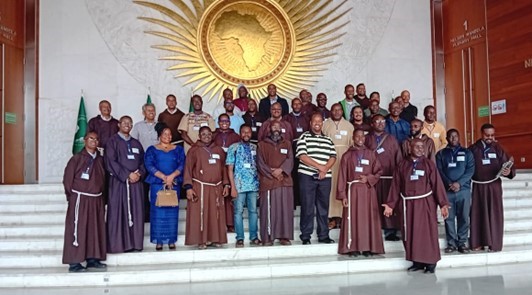
«The Pan-African Capuchin Congress (PACC) serves as a convoking of prominent Capuchin superiors from Africa and Madagascar, alongside the General Minister and his Councilors, to reflect on the experiences of the Capuchin Friars in Africa». BR. Worku Demeke, OFMCap.
The main purpose of the Congress is to strengthen the Capuchin identity within Africa by fostering the human and fraternal connections that underpin their existence, which include formation, mission, economic stewardship, and collaborative witness in partnership with local Churches and the global community.
As of now, PACC has taken place five times, with the sixth congress planned to be held at St Francis friary in Addis Ababa, Ethiopia, from February 1 to 6, 2027. Normally, the Congress is organized in one of the African countries, as determined by the General Minister and his councilors. The General Minister is responsible for convening and presiding over the Congress. The five previous congresses have been held in the following nations:
- The inaugural Congress took place in 1992 in Nairobi, Kenya (Analecta et Vol. 109 – N. 1, 1993, 126-126).
- The second Congress occurred in December 1996 in Pretoria, South Africa (Analecta et Vol. 113 – N.1, 1997, 118-134).
- The third Congress was held from December 1 to 5, 2001, in Nairobi, Kenya.
- The fourth Congress took place from October 27 to 31, 2008, in Dar Es Salaam, Tanzania.
- The fifth Congress was conducted from November 7 to 10, 2016, in Abidjan, Ivory Coast.
It is clear that a multitude of issues have been addressed in all these Congresses, resulting in various directives intended to influence the life and mission of the Capuchins in Africa. However, the resolutions made during the second and fifth PACCs hold particular importance. At the second Congress, it was decided that the Capuchins in Africa ought to be organized and coordinated in a more cohesive manner rather than being divided into smaller factions. Consequently, the previous associations, which consisted of two in East Africa and two in West Africa, have been dissolved, leading to the establishment of two new conferences, namely EACC and CONCAO. Additionally, during the fifth PACC, both conferences came to an agreement to form an assembly referred to as the Capuchin Assembly of Major Superiors of Africa, with the aim:
- to strengthen and reinforce the collaboration and partnership between the two conferences, particularly in the realms of formation, evangelization, and the exploration of new mission territories, among other areas.
- to tackle issues concerning the presence of the Order on the African continent;
- to continue the process of inculturating the Capuchin-Franciscan charism within African nations, while respecting our distinct historical and cultural contexts;
- to promote solidarity among the conferences by acknowledging “modern” expressions of witness as a prophetic sign of the renewal of Christian life and the pursuit of peace, justice, and the integrity of creation;
- to enable the exchange of personnel among the Conferences, taking into account the overall welfare of the Order, are some of the objectives.
When we concentrate on the VI PACC, the moto of the congress is “LET US START AGAIN”, a phrase used by St. Francis of Assisi to teach his followers that the spiritual life is a continuous journey rather than a destination, and no one should satisfied with his spiritual progress and exposed to pried. The topics that will be addressed in this congress consist of six:
- The importance of human relationship in Africa and the Capuchin identity;
- Fraternal economy in view of growth in human relationships;
- To form our young ones to grow both in human and Franciscan relationships;
- Mission as a Collaboration in human and fraternal relationships;
- Capuchin brothers’ relationship with the local Ordinaries;
- Justice Peace and Integration of Creation in Africa.
The Capuchin Assembly of major superiors in Africa has developed a strategic framework aimed at effectively addressing these issues, ensuring that the congress yields significant results. This strategic framework is organized into three primary timelines: which are the pre-celebration timeline, the celebration timeline, and the post-celebration timeline.
- The Pre-celebration timeline pertains to the period leading up to the 6th PACC celebration starting from the date of official convocation, Jan 20, 2026, focusing on setting the cornerstone. During this phase, two key activities are emphasized: identifying what we want to achieve and knowing where we are now. Concerning what we want to achieve, specific topics have been selected, objectives for each topic have been defined, and qualified experts have been appointed as contributors. As for assessing our current status, the designated experts for each topic have developed questionnaires to serve as baseline assessment tools, which have been distributed to each community. Subsequently, the responses from each community will be gathered and utilized as one of the resources for topic development. Once the topics have been thoroughly developed, they will be shared with each community again, providing them with an opportunity to offer comments or raise questions that can be addressed during the celebration.
- The Celebration timeline encompasses the duration of the 6th PACC itself scheduled for February 1-6, 2027, and is centered on mounting the pillars. The main activities during this timeframe consist of offering inputs, which encompass the compiled presentations and proposals from each expert regarding the specified topics, as well as producing outputs, which refer to the decisions and guidelines that will be communicated by the congress following comprehensive discussions.
- The post-celebration timeline refers to the period following the 6th PACC celebration and focuses on furnishing the house. This is the implementation phase, which will continue until the celebration of the VII PACC. The primary activities during this phase include achieving the desired outcomes and fulfilling the strategic objectives.
To ensure the effectiveness and impact of the congress, the participation of every individual brother is essential. Accordingly, as of January 20, 2026, all Capuchins operating in Africa are involved in a range of activities. These include reflecting on the questionnaires of the baseline assessment, contributing to the writing of articles related to the topics, being updated about the progress made by the preparatory commission, and engaging in prayer for the success of the VI PACC, among others. Consequently, to facilitate this, the assembly has established a webpage at the domain https://www.camsafrica.org/. Additionally, it utilizes social media platforms such as WhatsApp, WhatsApp channel, YouTube, Twitter, and others.
The anticipated number of participants includes 100 brothers along with a potential 30 invited guests. Therefore, the total expected attendance is approximately 130.