About Us
Origin of the Capuchins
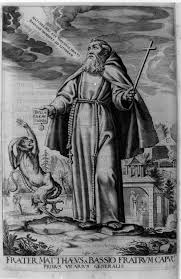
The Order was founded around 1525, when the Franciscan friar Matteo da Bascio – ordained priest in the Marche region, Italy – was convinced that the lifestyle led by the Franciscans of his time was not what Saint Francis had imagined. He wished to return to the original lifestyle in solitude and penance as practiced by the founder of his order.
His superiors tried to suppress these new notions, and thus Matteo and his first companions were forced to hide from the Church authorities, who wanted to arrest them for abandoning their religious obligations. These were the years of the Lutheran Reformation and, therefore, any attempt at renewal was badly regarded by the superiors of the religious orders. Matteo and his friends found refuge with the Camaldolese monks; in gratitude, they subsequently adopted the hood worn by that order, which was the hermit’s mark in the Marche region, in addition to wearing a beard. The popular name of their movement originates from this characteristic of their habit.
In 1528, with the mediation of Caterina Cibò, Duchess of Camerino, Matteo obtained the approval of Pope Clement VII with the bull Religionis zelus. He was given permission to live as a hermit and to go everywhere preaching to the poor. And this permission was not only for him, but for all those who would join him in his attempt to restore the most literal observance possible of the rule of St. Francis. Matteo and the original group were soon joined by others and initially they were called Friars Minor of the Hermetical Life and due to the opposition of the Observants, they became the congregation: the Friars Minor Hermits, a branch of the Conventual Franciscans, but with their own vicar.
From the second half of the 1700s to the end of the 1800s, the Order experienced a time of crisis. Bear in mind that between 1787 and 1847, no General Chapter of the Order was held, only assemblies of major superiors among groups of provinces divided up within the Order. These difficulties were due more to political-social than religious reasons. The French Revolution and similar experiences in other European states led to the suppression of friaries and even entire provinces. The same can be said for Italy in the late nineteenth century, where the law of Guarentigie deprived religious orders of many goods and even religious houses. However, this was accompanied by a more conscious missionary work, especially in the Americas, where the Order grew very rapidly.
Despite the difficulties at the beginning of the twentieth century, the Capuchins numbered around 9,500 in over 600 friaries. The General Chapter of 1884 had decided to repurchase many of the friaries that had been lost during the previous century and the new Constitutions were approved. The precedents were from 1643. The twentieth century was, for all religious orders, the century of the return to origins and the opening to novelties in the contemporary world. Consider the Second Vatican Council and the invitation to all religious communities to rediscover the original reasons for their charism. The Capuchins were not exempt from the crisis of vocations, which hit the Catholic Church in Europe and North America in the 1960s and 1980s. Nonetheless, the Capuchins remain one of the largest and most widespread orders of the Catholic Church.