WITNESSING FRANCISCAN CAPUCHINS VALUES AMONG THE GHANAIANS: History, Activities and Evangelization Work of the Franciscan Capuchins in Ghana
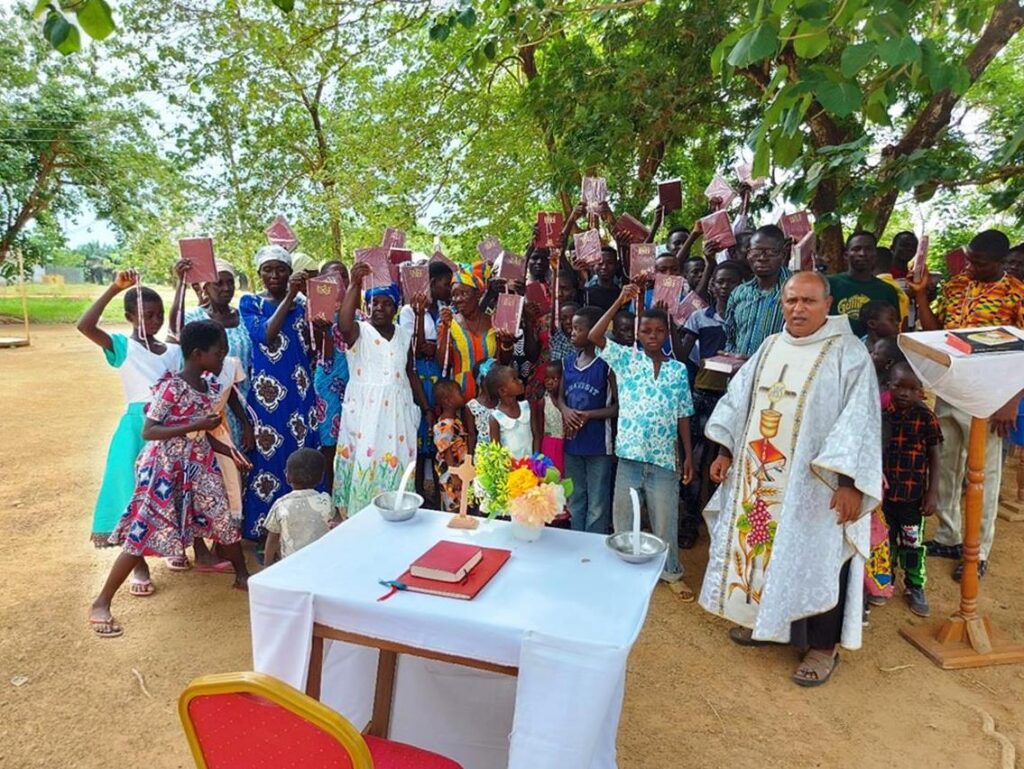
OUR PRESENCE In 2005, the Capuchin Province of St. Francis of Assisi in Kerala, India, answered a call from the Diocese of Novrongo-Bolgatanga in Ghana’s Upper East Region, establishing a mission there. Starting as a House of Presence, it officially became a Provincial Delegation in 2016 under Bro. Varghese Alphonse. After a three-year term, Bro. Varghese Alphonse was re-appointed in 2020, followed by Bro. Robinson Melkis’s appointment in 2022, marked the continued dedication of the Capuchins to their mission in Ghana. The political and ecclesial situation of Ghana is very healthy. The country is a peaceful democracy with regular elections. There was some unrest when new regions were created, but tensions have subsided. Ghana is predominantly Christian, with Catholicism being the largest single denomination. Religious tolerance is high, and missionaries are respected. The government recognizes the Catholic Church as a major contributor to healthcare and education. Evangelization in Ghana began with the arrival of SMA Fathers and Missionaries of Africa in the late 19th century. Since then, many missionary congregations have played important roles in spreading the faith. The Capuchins arrived in Ghana in 2005 and established communities in various locations.The Capuchins initially served in Kongo from 2005 to 2021, caring for the Spiritual Renewal Centre and Marian Grotto. The decision to leave Kongo was due to several factors, including lack of friars and limited opportunities for expansion. Then, in 2008, they established the Kpassa community and started to engage themselves actively in evangelization and development work. In 2018, they established a new community in Sunyani diocese, accepting the invitation of the Bishop of Sunyani to manage St. Joseph’s Retreat and Pastoral Centre. Three friars arrived in March 2018, residing temporarily in the Pastoral Centre until an old residential house of the Dioceses is renovated. Since the agreement made in 2020 with the Bishop allows them only a limited presence at the retreat center, they bought two acres of land in view of establishing their own fraternity house and school. Finally, after years of pursuit, the Capuchins officially started their mission in Accra Archdiocese in October 2020. The Archbishop welcomed them to manage St. John the Baptist Church at Prampram, Accra. Then in August 2022, they solidified their presence by signing an official contract with the Bishop. OUR ACTIVITIES Pastoral activities One of their biggest parishes is the one at Kpassa. Currently, the parish serves in addition to the main church 20 outstations in remote villages. Traveling to reach all outstations is a big challenge due to poor road conditions. Despite the challenges, the Capuchins are committed to serving the diverse needs of the communities. The pastoral service includes YOUFRA (KCYM), which is a vibrant youth ministry that fosters faith, fellowship, and service through various activities like playing various games through which the spreading of the Franciscan values and engaging with other communities are practiced; distributing over 4500 Bibles and thousands of rosaries and other items; building proper churches in various villages to enable communities to worship and grow together. Social activities Recognizing the importance of holistic development, the Capuchins provide various social services like provision of access to clean water by digging boreholes and corn mills for the ease of food preparation; distribution of clothes; provision of bicycles and umbrellas to enable easier travel; provision of educational materials; provision of medical needs (when possible); building homes for the poorest families; food assistance (in times of need); provision of sewing machines, provision of machines for fishing are some of them. The social activities of the brothers are not limited to addressing the basic needs, but they go further to provide services of education. They have already established four schools: IMPACTS The impacts of the Capuchin mission on the society is very significant. To mention some of them: CHALLENGES There are lots of challenges that each brother is facing each day; however, the pertinent and common challenges are: NUMBER OF FRIARS The Capuchin mission of Ghana is currently comprises thirteen friars, all hailing from St. Francis Province, Kerala, India. The friars are distributed across three communities; though we had four communities, the first community was closed due to inadequate friars: Contact person: Br. Robinson Melkis OFM Cap. (Mission Delegate- Ghana) Addresses: Mary Queen of Angels Provincial Delegation – GHANA (St. Francis Province, Kerala, India) P.O. BOX – 48, Nkwanta, Oti Region, Ghana TEL: +233-242627462; Email: ofmcapghana@gmail.com August 11, 2025 By Br. Robinson Melkis OFM Cap